

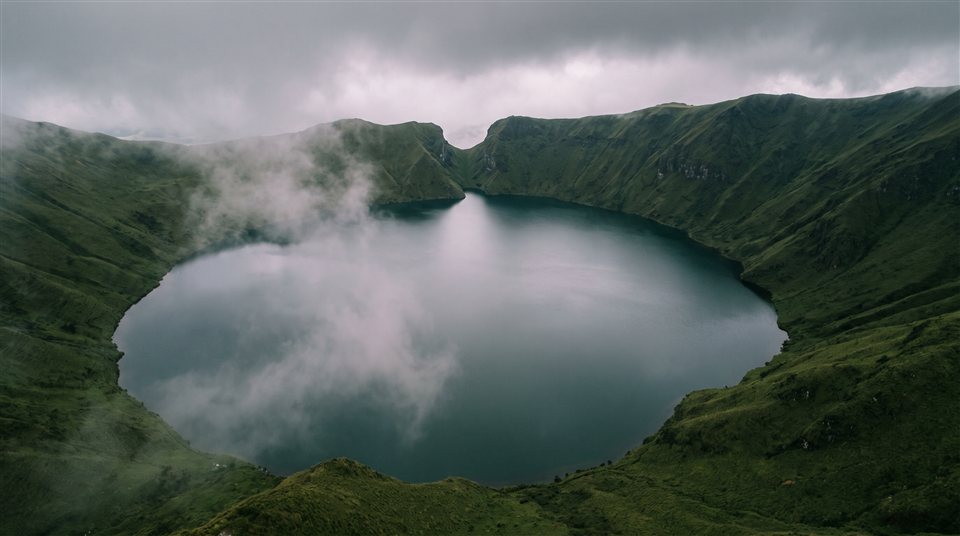
Here is a fact that ruins a good quiz answer. El Dorado was never a place. Not a city, not a kingdom, not a temple stacked with gold bricks. It started as a man, and that man was real.
What actually happened at Guatavita
The Muisca lived in the cold highlands around what is now Bogotá. They were not a lost golden civilization. They farmed, they wove cloth, and they traded salt and emeralds the way other people traded money. Gold barely mattered in their economy, which makes what happened next a little absurd.
When a new chief took power, the ceremony took place on a lake. Guatavita is an almost perfect circle of water sitting inside an old crater, ringed by green hills. It looks staged, even though nobody built it.
The chief was undressed. His skin was covered with a sticky resin, then gold dust was blown over him until no bare patch was left. He was taken by raft to the middle of the lake. There he threw gold and emeralds into the water as an offering, not as payment and not as a show, and then washed the dust off in the same water.
To the Muisca, none of that gold was lost. It had gone exactly where it belonged.
He was not the ruler of a golden city. For one cold morning, he was simply a very gold man on a raft.
How a man became a kingdom
The Spanish never saw the ceremony. They heard about it secondhand, from people who had heard it from someone else. What reached them was el hombre dorado, the gilded man, and it was already changing shape.
You know how this goes. A rumour never survives retelling, especially when the people repeating it want it to be true. The gilded man became a gilded king. The king needed a palace, so he got one. The palace needed a city, so that appeared too, with streets paved in gold, because why stop halfway.
For almost two centuries, expeditions went looking for that city. They crossed Colombia, Venezuela and the Guianas, and pushed deep into the Amazon, following rumours that got vaguer with every mile. Men died of hunger and fever chasing a myth built on top of one real afternoon.
The proof nobody expected
For a long time even the ceremony sounded invented. Then, in 1969, a farmer near a cave south of Bogotá found a small gold object that he almost sold as scrap.
It is a raft. A tiny gold model, about the size of a hand, with a central figure standing taller than the others and attendants around him. It was made by someone who was there, or whose grandparents were. Today it sits in the Museo del Oro in Bogotá, and it is the single object that proves the whole story.
The city was a fantasy. The man on the raft was not.

What they did to the lake
Naturally, somebody decided the answer was obvious. If the treasure is in the water, take the water out.
Colonists cut a channel into the rim of the crater to drop the level, centuries before anyone had the tools to do it properly. Then, at the end of the 1800s, a British company drained Guatavita almost dry.
They found a few things. Nowhere near enough to cover the cost, and nothing like the hoard they had pictured. The mud baked solid in the sun before they could search most of it, which feels like a fair ending.
Guatavita is protected today. No diving, no dredging, no more expeditions.
Why nobody was ever going to get this right
The real gap was never about maps. It was about what gold is for.
The men who came looking treated it the only way they knew: something you dig up, weigh and carry home. The Muisca treated it more like a word. It was a way of speaking to Sué, the sun, whose light they believed gold actually was, cooled and settled into the ground.
One side threw gold into a lake on purpose, out of respect. The other spent three hundred years trying to get it back. Both were completely sincere, and neither ever understood the other.